
 8 hours ago
Published March 15, 2026 03:19AM
A friend of mine ran for the University of Arkansas during its dynasty years in the 1990s. Each fall, a new group of wide-eyed recruits would arrive for their first workout alongside returning NCAA champions and Olympians from around the world. The coach would assign a session—five times a mile, for example—and send them to the start. The nervous rookies would then approach the veterans and ask, “So, um, how fast are we supposed to run these miles?” The veterans would reply stonily, “I don’t know. How fast can you run them?”
Figuring out the right intensity is one of the fundamental challenges of training. These days, instead of pushing interval workouts as hard as possible, many runners have adopted the so-called Norwegian Method, using lactate measurements or heart rate monitors to ensure they don’t push too hard. But there’s still plenty of debate about how difficult the ideal workout should be. A new study in Medicine & Science in Sports & Exercise suggests a surprisingly simple answer: it should feel like 7 on an effort scale of 0 to 10. And even if you think that answer is too simple (which you definitely should), the study offers interesting insights about the physiology and psychology of the optimal workout.
What the New Study Found
A research team led by Daniel Bok of the University of Zagreb, Croatia, recruited 17 runners to complete a series of three workouts. Each workout consisted of 3 x 3:00-minute intervals with two minutes of rest; the desired intensity was either 6, 7, or 8 on a scale of 0 to 10, corresponding to somewhere between “hard” and “very hard.”
The researchers focused on how much time the runners spent above 90 percent of VO2 max. VO2 max measures aerobic fitness, representing the maximum rate at which your body can take in oxygen, absorb it into the bloodstream, deliver it to muscles, and use it to fuel activity. To improve fitness, you want to spend as much time as possible near this maximal or near-maximal state so your body adapts to process more oxygen. If you go too easy, you won’t push your system to adapt; if you go too hard, you’ll fatigue too quickly. Between these extremes lies a sweet spot that maximizes time near VO2 max.
Here’s a graph showing the fraction of workout time spent above 90 percent of max heart rate (black bars) and above 90 percent of VO2 max (white bars) for the three effort levels 6, 7, and 8:
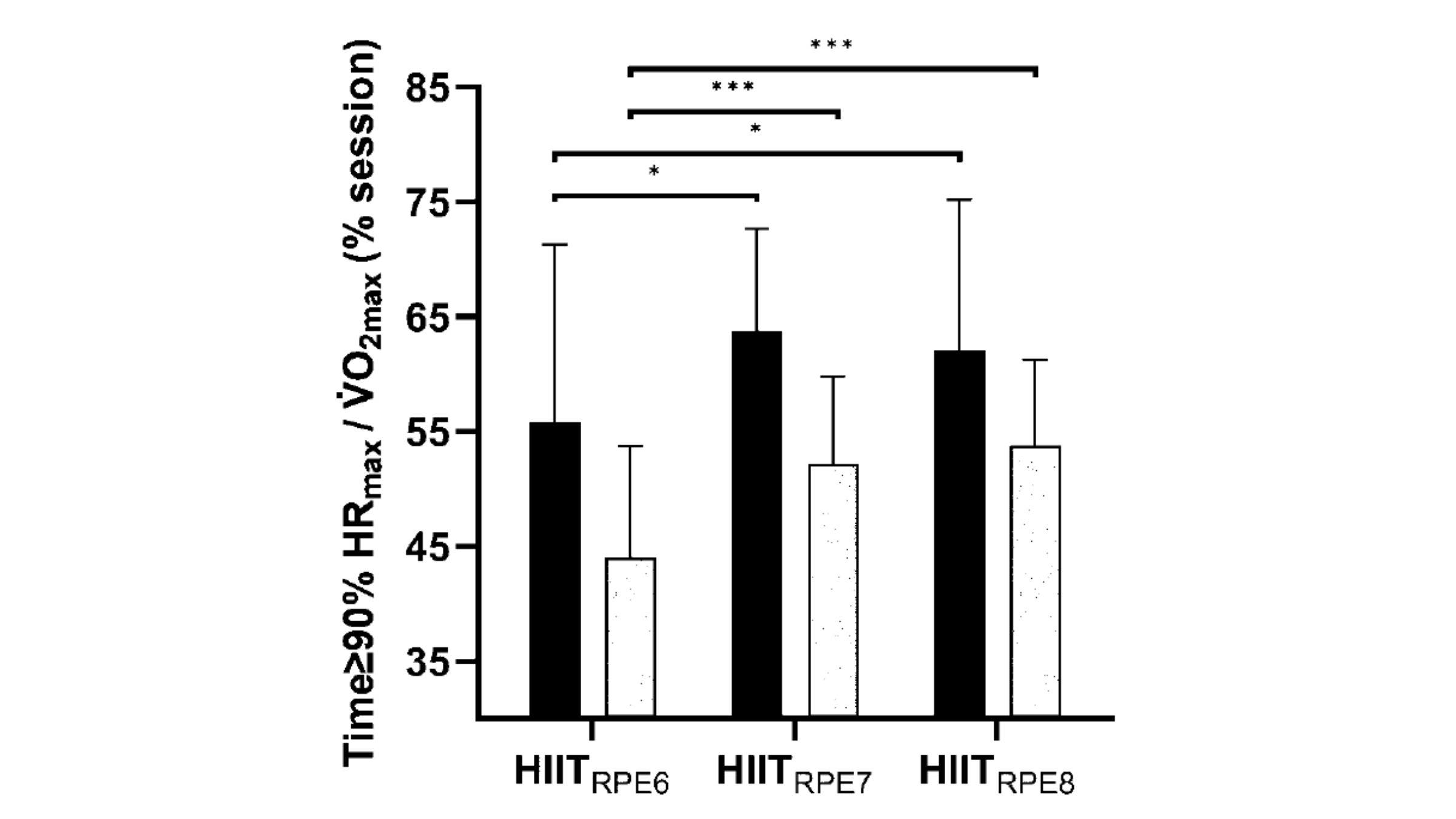 The amount of time spent above 90 percent of max heart rate and VO2 max is greater when you push at a subjective effort of at least 7 out of 10. (Photo: Medicine & Science in Sports & Exercise)
For both heart rate and VO2 max, the workout at effort level 6 was less effective at accumulating time above 90 percent. The two harder workouts, at effort levels 7 and 8, were essentially the same, with no statistically significant differences. This is why the researchers claim that 7 out of 10 is a sweet spot: it provides more training benefit than effort level 6, and there’s no added benefit from pushing to level 8.
The Real-World Takeaways
Despite this finding, the study’s main message isn’t that all workouts should be done at effort level 7. For one, this particular workout includes only nine minutes of hard effort—and the graph shows that time above 90 percent of max heart rate has already peaked. For longer workouts, like 6 x 3:00 or 3 x 6:00, the sweet spot to maximize time above 90 percent would likely be a slightly lower effort.
From the researchers’ perspective, the key takeaway is that perceived effort is a useful guide for workouts. The harder the runners were instructed to push, the faster they ran and the harder they breathed (measured by the volume of air inhaled and exhaled each minute). Given that they ran on a track with no clock or speed feedback, this isn’t trivial—it confirms that we intuitively understand the difference between efforts of 6, 7, or 8 out of 10.
There’s also a subtle nuance: the runners were told to pace themselves so their effort matched the goal level (e.g., 7) at every moment during the interval. They didn’t guess a steady pace that would feel like 7 by the end of three minutes—instead, they started fast and gradually slowed as they fatigued, adjusting pace to maintain a constant perceived effort of 7 out of 10.
This pacing style is unusual. A decade ago, I tried an experimental VO2 max test based on this principle: for each two-minute stage, I adjusted my pace to maintain a certain perceived effort, meaning starting fast then slowing down. The final stage required starting at an all-out sprint and gradually slowing the treadmill just enough to avoid falling off. I was suspended in a safety harness during the test, which was brutal—I vomited shortly after finishing.
This fast-start pattern caused the subjects in Bok’s study to spend more time above 90 percent of VO2 max than if they had run each interval at a steady pace. Bok and colleagues suggest this might be a better way to run intervals for greater fitness gains. While the logic is sound, this claim needs verification through a multi-week training study. Personally, I find it hard to imagine running workouts this way (perhaps due to that vomit-inducing VO2 max test) and wonder if it might reduce practice for even pacing in races.
To me, the study’s most important implication is that harder isn’t always better. Increasing effort from 7 to 8 feels tougher and likely requires longer recovery, but the training signal—measured by lactate levels and time above 90 percent VO2 max—is no stronger. For this 3 x 3:00 workout, the sweet spot was an effort of 7 out of 10. While we can’t directly apply that number to all workouts, the underlying principle is clear: if you want to know how fast to run your intervals, “as fast as possible” isn’t necessarily the right answer.
For more Sweat Science, sign up for the email newsletter and check out my new book The Explorer’s Gene: Why We Seek Big Challenges, New Flavors, and the Blank Spots on the Map.