 6 hours ago

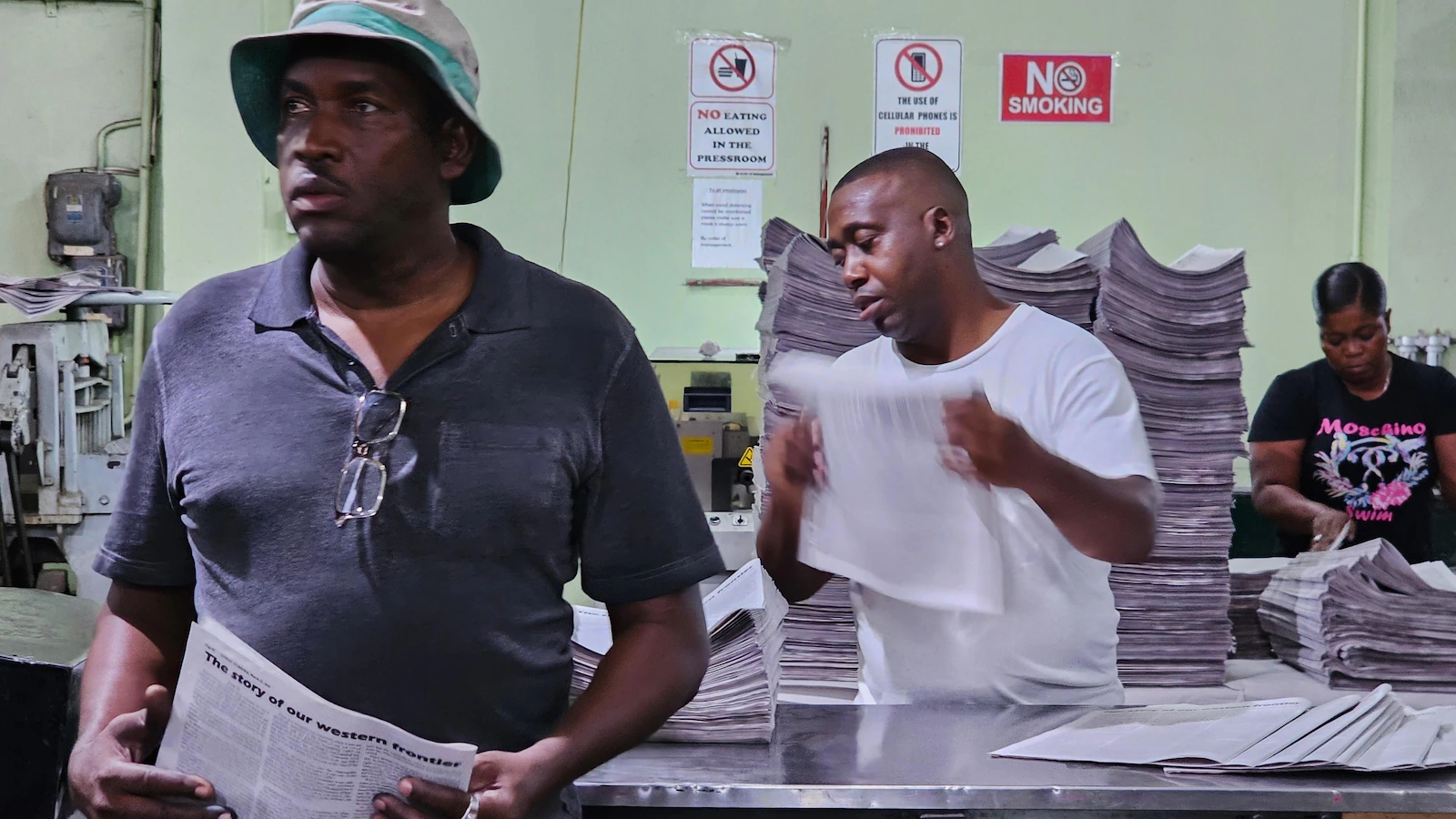
Two major Caribbean newspapers have closed this year as readers increasingly rely on social media for news instead of traditional print outlets. The shutdowns of Guyana's Stabroek News and Trinidad and Tobago's Newsday represent a significant loss for independent journalism in the region.
SAN JOSÉ, Costa Rica (AP) — Carlon Augustus, who grew up in Trinidad and Tobago, recalls his grandparents buying newspapers daily. Now 32, he depends on social media platforms to stay informed about current events.
For Augustus, immediate access to information shapes his news habits. "Everything is on social media now. Whatever happens today, you don’t have to wait to get the papers tomorrow," he explained.
Publishers cite changing reader preferences like Augustus’s as the main reason behind the closure of these two established Caribbean publications this year.
Stabroek News published its final print edition on Sunday and ceased online operations. Founded in November 1986, the paper was established one year after its founder received permission from Guyana’s president to create an independent news organization. Guyana would hold its first democratic elections in nearly three decades six years later.
Trinidad and Tobago’s Newsday ended both print and digital operations in January.
"That is definitely a loss to the country, to our democracy, where particularly in this age of social media, credible professional media houses are needed more than ever," said Judy Raymond, former editor-in-chief of Newsday.
Caribbean newspapers, which have reported on government corruption, political turmoil, devastating hurricanes, and unique human interest stories, face challenges maintaining readership—mirroring global struggles in print journalism—and cannot compete with social media personalities and digital platforms.
The closures particularly impact the media landscape because both newspapers operated independently, offering diverse perspectives and remaining less vulnerable to pressure from advertisers or influential figures, according to Kiran Maharaj, president and cofounder of the Media Institute of the Caribbean.
"You have now a narrowing of that," she observed.
Stabroek News was known for reliable, unbiased reporting and set editorial standards emulated throughout the Caribbean. It attracted renowned writers for opinion pieces, including Guyanese poets Martin Carter and Ian McDonald, and provided extensive coverage of the historic October 1992 elections that restored democratic governance.
The newspaper also became a venue for public discourse after years under authoritarian rule.
"Its letters page provided perhaps the most open and democratic public forum in Guyana," attorney Christopher Ram wrote in a recent commentary published by the paper. "Over time that column became something of an informal national meeting place where academics, trade unionists, political figures, public servants, businesspeople and ordinary citizens debated, as equals, matters of public importance."
Stabroek News held the position as Guyana’s leading newspaper. Three other publications remain in the country: one government-controlled, another closely tied to the current administration, and a third recently surveying website users about willingness to pay for digital content.
Early Ward, a 76-year-old retired beverage industry manager from Guyana, expressed sadness over Stabroek News ending publication. "I have been reading newspapers since the 50s and prefer to have one in my hand to hold and to move around with and read anytime," he shared. Ward now relies on television and social media for news updates.
Newsday launched in 1993 in Trinidad and Tobago, aiming to serve the most isolated areas of the dual-island nation where two established competitors remain: the Trinidad and Tobago Guardian and the Trinidad Express.
The publication attracted working-class readers and quickly gained recognition as reporters broke major stories ahead of competitors, with legislators citing its articles during parliamentary sessions.
Newsday distinguished itself through coverage of Tobago, the smaller and less economically developed island, and by highlighting voices of disadvantaged residents, noted Judy Raymond, who served as editor-in-chief from 2017 to 2022.
She described one of her most rewarding roles as helping people "because they are desperate and officialdom has not helped them and they don’t have anybody else to turn to."
Caribbean newspapers enjoyed strong financial support and represented social status from the 1970s through the mid-1990s, said journalist Wesley Gibbings, vice president of the Jamaica-based Media Institute of the Caribbean. "People would be seen walking with a physical copy of newspapers," he recalled. "It was almost a prestigious thing to be the one with the newspaper."
Technology companies like Google later captured advertising dollars and revenue while using content from traditional news organizations, Gibbings explained. "The danger signs have been up for a very long time," he said. "We are in a watershed period right now, and the crashes will continue."
Daily News Limited, publisher of Newsday, closed due to multiple simultaneous challenges, according to managing director Grant Taylor, who noted print advertising revenue dropped 75% over the past decade.
Raymond, who established Newsday’s digital operations in early 2018, suggested the publication "could have worked harder at broadening the revenue stream from online publications."
Reflecting back, she questioned whether converting Newsday to an online-only format might have sustained operations. However, citing Loop News, a regional digital news platform that closed last July, she acknowledged that digital-only publishing would not have guaranteed Newsday’s survival.
Regarding Stabroek News, ownership reported the government contributed only $7.5 million toward approximately $90 million in outstanding advertising bills from the previous year.
However, the publication clarified that unpaid invoices and reduced government advertising were not primary causes of closure: "Readership patterns have changed dramatically, and fewer readers are willing to purchase printed editions—or even pay for electronic versions."
In a recent letter to Stabroek News, Lurlene Nestor lamented its closure, "especially during this period of Guyana’s history, where allegations of massive public corruption are rife, coupled with a situation where the nation’s important resources, such as gold and oil, appear to be either corruptly exploited or used as personal political bargaining chips."
Anand Persaud, Stabroek News’ editor-in-chief, shared similar concerns while expressing pride in the publication’s work. "We leave at this stage," he stated, "because we want to make sure our independence is not on the line."